
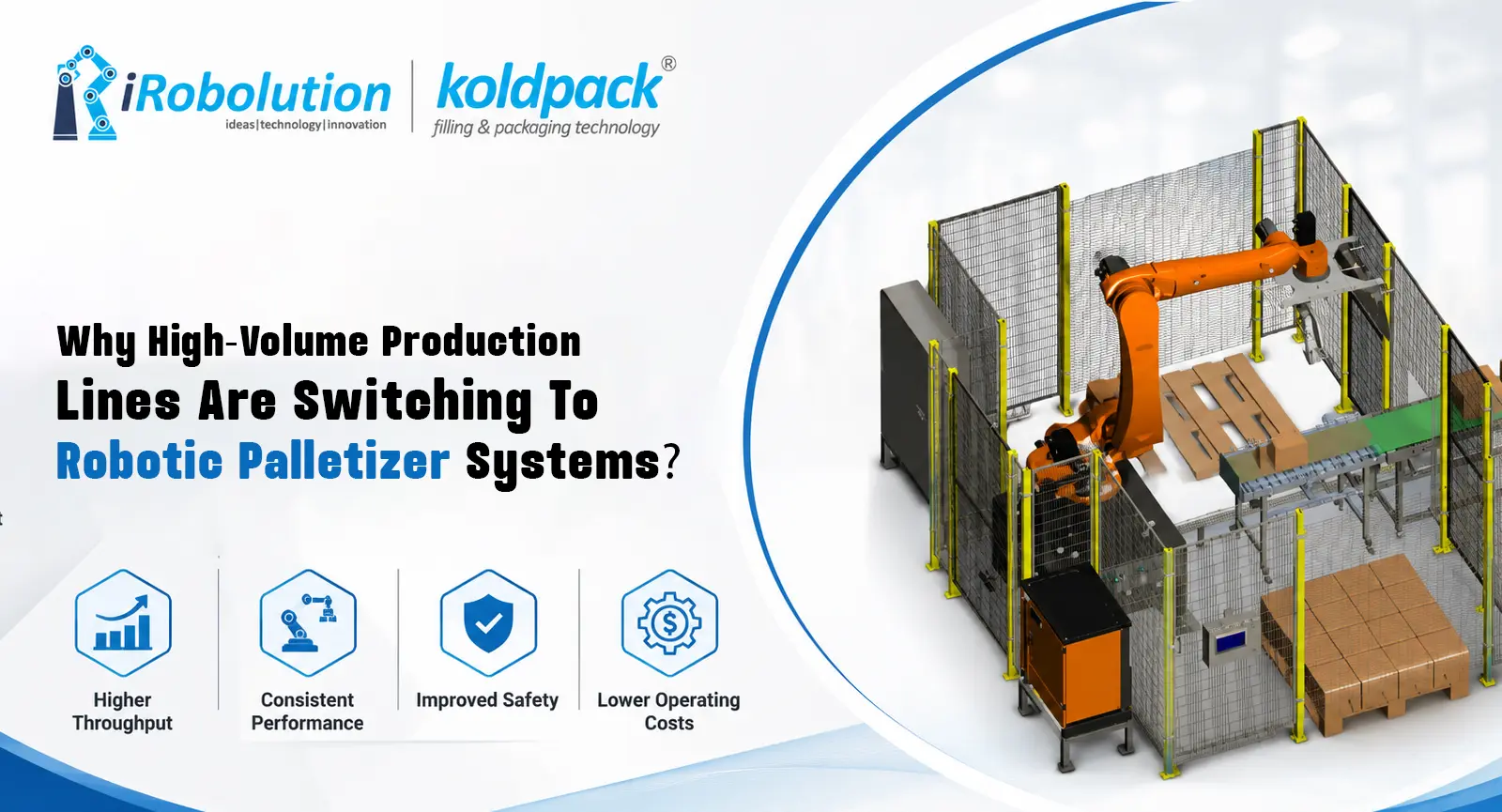
The Problem That Manual Palletizing Creates at Scale
Manual palletizing is one of those tasks that looks manageable until the production volume increases. At low speeds with consistent product sizes, trained workers can keep up. But push the line faster, introduce multiple SKUs, run extended shifts, or try to maintain consistent pallet patterns across thousands of units, and the cracks start to show. Inconsistent stacking leads to unstable loads. Unstable loads damage product in transit, create safety risks in the warehouse, and generate returns and complaints that trace back to the end of the production line. Workers performing repetitive heavy lifting through an eight-hour shift make errors toward the end that they do not make at the beginning. And when a key palletizer goes off sick, the downstream consequences for dispatch can be significant. This is a structural limitation of manual processes at high volume, and it is exactly what Robotic Palletizer systems are designed to address.How a Robotic Palletizer Works?
Consistent Speed, Every Cycle
A Robotic Palletizer does not slow down at the end of a shift. It stacks at the same speed with the same precision on cycle 1 and cycle 10,000. For high-volume production lines where throughput consistency is directly linked to dispatch schedule reliability, that consistency has financial value.Precision Pallet Building
Pallet pattern accuracy matters more than most people outside logistics realise. A correctly stacked pallet interlocks layers for stability, maximises the number of units per pallet, and reduces the risk of product damage during transport. Manual stacking introduces variation that accumulates across layers; what looks acceptable at pallet layer three creates a stability problem at layer eight.Workplace Safety
Palletizing is physically demanding. Repetitive heavy lifting causes muscle injuries over time, and these injuries are costly for packaging equipment manufacturers in terms of workers’ compensation, absenteeism, and the operational disruption that comes when experienced workers are off the floor. Automating palletizing removes the repetitive, heavy lifting from the work. Workers are redeployed to tasks that require judgment, flexibility, and skill, things robots are not good at. The palletizing robot handles what it is better at, which is consistent repetitive physical work at sustained speed.The Industries Making the Switch to Robotic Palletizer Systems
FMCG and Food & Beverage
FMCG and food & beverage operations were among the earliest to adopt Robotic Palletizer systems at scale, and they remain the largest application category. The combination of high production speeds, multiple SKUs running simultaneously, and strict hygiene requirements makes robotic palletizing the right choice. Our systems handle bottles, cans, cartons, and multipacks across food and beverage production lines, formats that vary significantly in weight, geometry, and fragility, requiring the kind of adaptable end-of-arm tooling that a well-configured robotic system provides.Pharmaceuticals
Achieving specific compliance requirements for pharmaceutical palletising is challenging for manual operations. The robotic system delivers the precision and data-logging functionalities necessary for box orientation, pallet pattern documentation, and traceability requirements. iRobolution’s systems are GMP and CE compliant, a fundamental requirement in pharmaceutical manufacturing environments.Chemicals and Industrial Products
Chemicals and heavy industrial containers, drums, barrels, and large industrial packaging present challenges for manual palletizing that go beyond fatigue. Heavy loads that require mechanical assistance when handled manually become routine operations for a Robotic Palletizer configured with the right end-of-arm tooling. The safety case for automation in chemical palletizing is particularly strong.Logistics and Distribution Centres
High-volume SKU palletizing and distribution centres deal with mixed SKU and order-based pallet stacking that changes constantly. A Robotic Palletizer that can switch between pallet patterns without mechanical intervention, by selecting from pre-programmed recipes, handles this variety far more efficiently than manual operations that need to be reorganized around each product changeover.Industry 4.0 Integration: What It Means on the Production Floor
A Robotic Palletizer is not a standalone machine. These are built with Industry 4.0-enabled technology, which means they are designed to communicate with the broader production environment rather than operating in isolation.Integration With Conveyors, AGVs, and AMRs
The systems also integrate with conveyors, AGVs (automated guided vehicles), and AMRs (autonomous mobile robots) to create a connected end-of-line system, instead of a series of disconnected operations. Product flows from the packaging line to the palletizing cell to the warehouse in a managed, monitored sequence. When one element of the system needs attention, the integration allows the system to flag it before it becomes a production stoppage.Live Monitoring and Uptime
The ViPoCo Technology software platform behind these systems enables live monitoring of the palletizing operation. Cycle times, error rates, pallet completion status, this data feeds into the production management system and gives line managers visibility they simply do not have with manual operations. After-sales service is also provided, specifically aimed at achieving 100% customer satisfaction and ensuring uptime, which reflects the understanding that a Robotic Palletizer has to be a reliable production asset, not a machine that generates its own maintenance burden.What to Look for When Evaluating a Robotic Palletizer System?
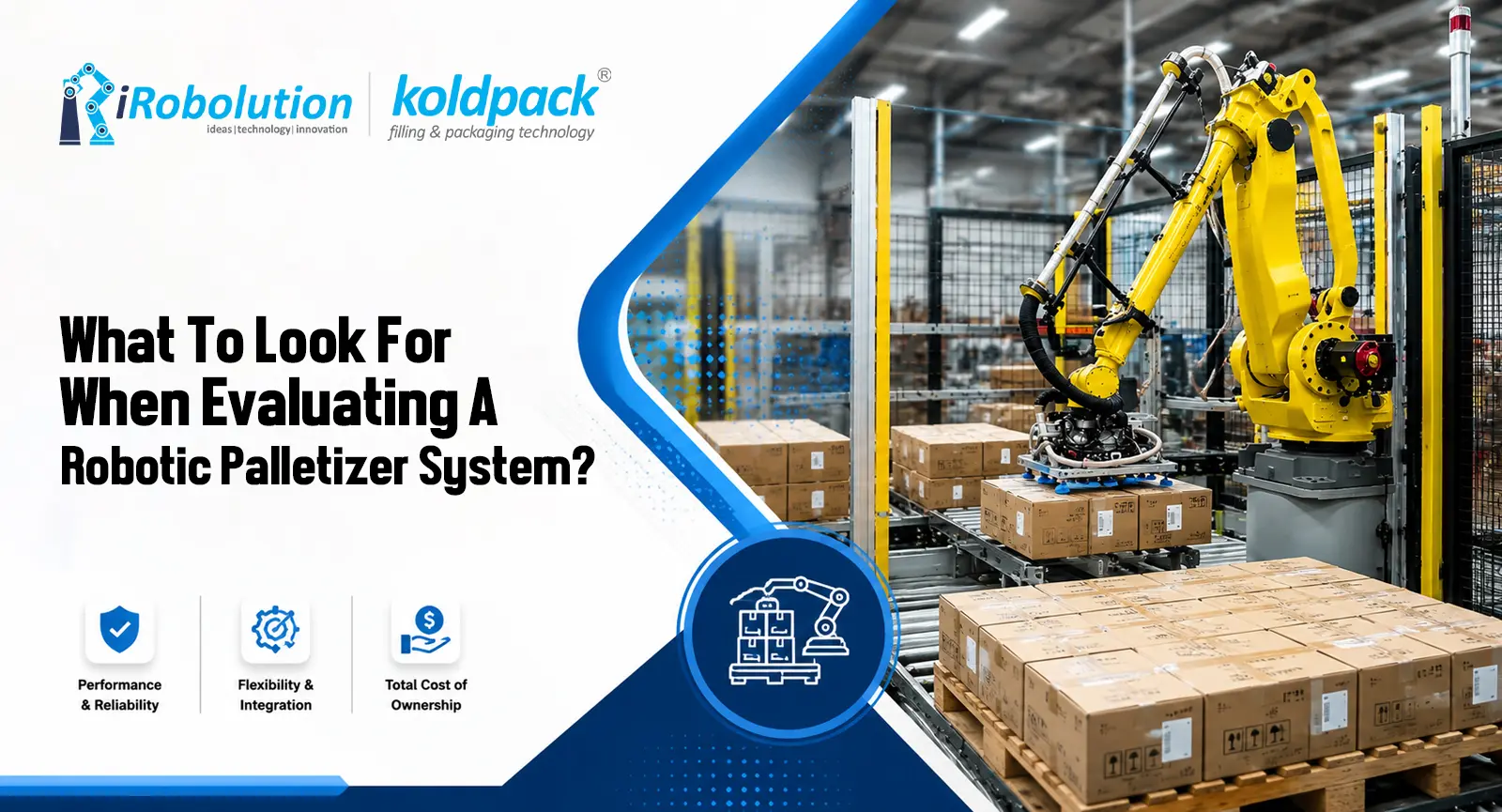
SKU Flexibility
If your operation runs multiple product formats, the system needs to handle them all without significant changeover time. Confirm how many pallet patterns the system stores, how quickly the operator can switch between them, and whether new patterns can be added without specialist programming.Integration Capability
A Robotic Palletizer that cannot integrate with your existing conveyor system, your warehouse management system, or your future AGV and AMR plans creates a connectivity gap that limits its value. Industry 4.0 integration capability is specifically designed to address this; the system is built to connect, not to operate as an island.After-Sales Support
For a production system, after-sales support is as important as the initial specification. Our commitment to after-sales service aimed at customer satisfaction and ensuring uptime reflects a genuine understanding of what a palletizing system needs to deliver over its operational life.Conclusion
The switch to Robotic Palletizer systems is not happening because the technology is new or because manufacturers are chasing automation for its own sake. It is happening because high-volume production lines have reached a point where manual palletizing is the constraint, in throughput, in consistency, in safety, and in the operational flexibility to handle varied product mixes without disruption. iRobolution, with over 20 years of experience as a packaging equipment manufacturer and an Industry 4.0-enabled technology platform, builds palletizer systems designed for exactly this environment.FAQs
Irobolution
Irobolution is a reputed name in the manufacturing and supply of advanced packaging equipment.