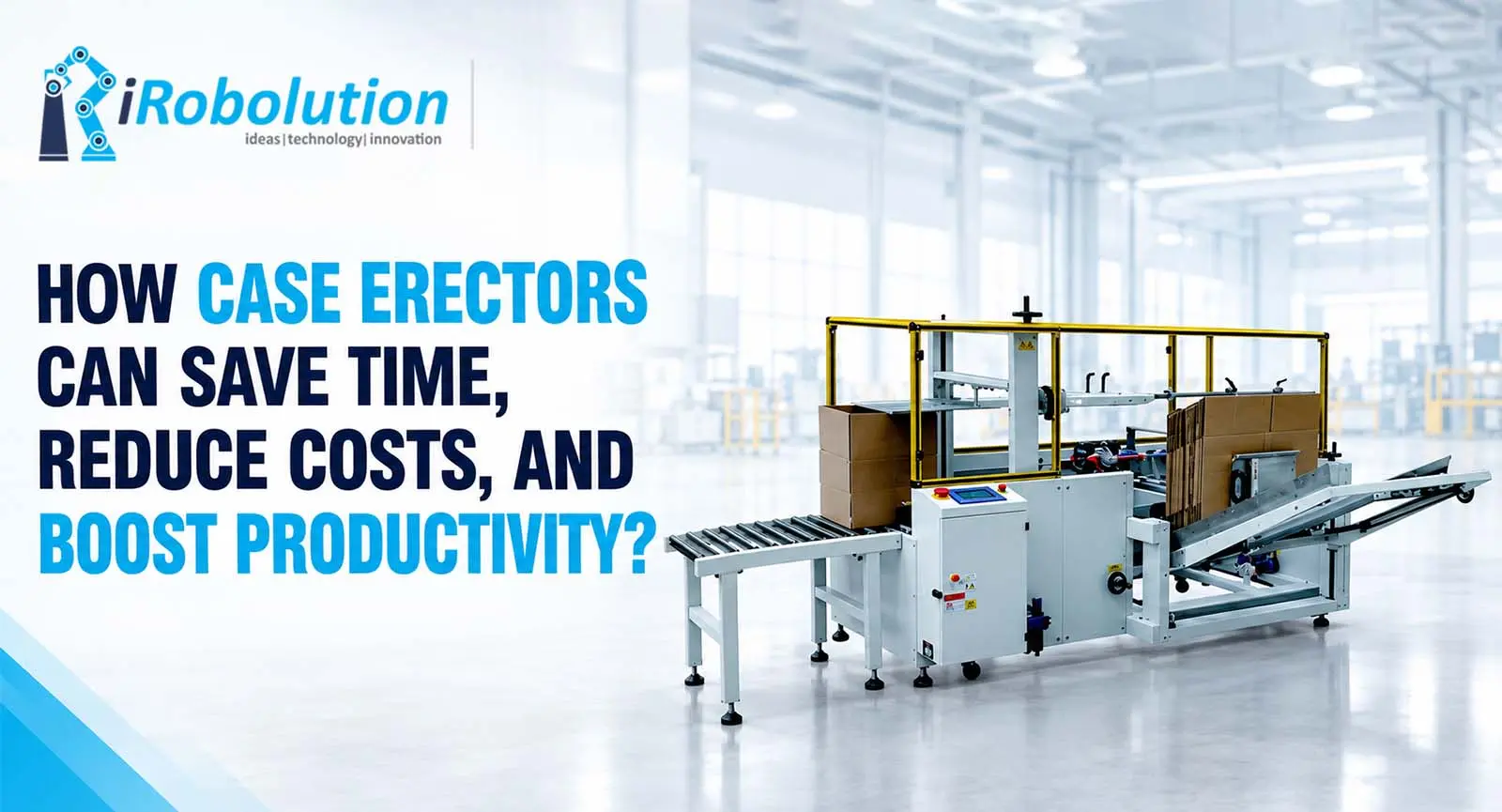
Quick Summary: A case erector pulls a flat corrugated blank from a stack, opens it into a box, and seals the bottom, so a square carton reaches your packers without anyone folding it by hand. This article is all about what happens inside the machine, how it saves time and money, how vertical, horizontal, and robotic designs differ, and what to check before you buy one.
Table of Contents:
Introduction
Inside a case erector, one simple sequence repeats every few seconds: a flat blank gets pulled from a stack, opened into a box shape, and sealed at the bottom so it holds that shape. That is the whole work, yet the way a machine performs it decides how fast your line runs and how well your cartons survive a pallet. The reason lies in what the machine replaces. A person folding boxes by hand manages about three per minute, tires over a shift, and forms cartons that vary slightly from one to the next. A machine produces the same carton at ten, fifteen or twenty-five per minute, hour after hour. This article explains what happens inside this erector, how it saves time, helps in managing the expensis, and lifts productivity, and how vertical, horizontal, and robotic designs differ. It also lists what to check before you speak to case erector manufacturers, so your first conversation covers the right questions.What Happens Inside a Case Erector
A case erector looks complicated from the outside, but it only does four simple things. Here is how a flat sheet of cardboard becomes a ready box:- Loading the magazine. An operator stacks flat blanks into a magazine. Irobolution’s iR-HMCE-25 holds 80 to 100 cartons, which sets how often someone refills it. Blanks should go in flat, dry, and aligned, because warped blanks cause jams.
- Picking and opening. The case erector separates one blank from the stack and opens it into a box shape. Many designs use suction cups for the pick, much like the cups that lift glass sheets in a factory. Pulling exactly one blank at a time is what prevents double feeds.
- Folding the flaps. Once the carton is square, the bottom flaps fold in and lock that squareness. If you fold them while the carton is still moving, a jam is likely.
- Sealing and discharge. The machine tapes the bottom, then passes the finished carton to your packing station or case packer. On Irobolution’s iR-HMCE-25, tape width is 48 or 60 mm, so confirm which suits your cartons.
How a Case Erector Saves Time, Cuts Costs and Lifts Productivity
The benefits show up in three places, and each one has a number you can check against your own plant:- Time: Industry figures show that hand erecting three boxes takes about one minute per box, and a basic machine takes ten minutes for the same work. For 1,200 cases a day, that is 400 minutes of folding against 120. Some mechanical models run 8 to 15 cartons per minute and list a two-minute changeover, so size changes cost little time.
- Cost: One industry estimate says seven people hand-form 30 cases per minute, while one machine matches that output. Add tape applied consistently, fewer crushed cartons on stacked pallets, and floor space no longer lost to piles of pre-built boxes. One manufacturer puts break-even near 600 boxes a day, and Irobolution says this case erector can make sense from 500 cases.
- Productivity: Packers and fillers perform best when boxes arrive at a steady rate, and a machine supplies that rate all shift. Operators move from folding to loading blanks and watching alarms. A Dutch flower grower replaced manual carton building by two employees with an erector rated up to 30 cases per minute and gained smoother production and lower labor costs.
Vertical, Horizontal or Robotic: Which Design Fits?
Case erector manufacturers build three main designs, and each answers one question: how varied are your cartons? Lets discuss the following types of case erector:- Vertical mechanical: The iR-MCE-10 forms 8 to 10 cartons per minute, and the iR-MCE-15 forms 12 to 15. Each handles one carton size at a time, with recipe settings and part changes for new sizes. They suit plants with steady cartons and moderate speed.
- Horizontal Case Erector: The iR-HMCE-25 serves fast lines at up to 25 cartons per minute. It measures about 2.1 by 1.2 metres and weighs 800 kg, so check floor space before you order.
- Robotic: The iR-iNovatRCE erects different carton sizes in programmed steps, serves two to four lines with one robot, and runs 8 to 12 cartons per minute. It includes a bottom taping and flap closing unit, an infeed conveyor, and a touchscreen, which makes it the choice for mixed pack sizes.
How to Choose the Right Case Erector
Before you decide on which one you should go with, make sure you go through these points:- Jam control: Jams usually start in four places: blank feeding, irregular blanks from the supplier, the forces of opening and folding, and moving the formed carton. Ask how each is handled.
- Carton quality: Board grade, score depth, and dimensional accuracy all affect squareness, so test your own cartons before you buy a case erector.
- Speed with headroom: Choose a rated speed above today’s need, because volumes tend to grow.
- Support: Ask case erector manufacturers about spares, response time, and training. A stopped erector stops the whole line.
Conclusion
Every packing line has one step that sets the pace, and boxing is often it. A case erector takes that work off your team, so packers pack, pallets move and shifts end on time. The best results come from matching the machine to your cartons, volume and floor space. Irobolution builds mechanical and robotic models in Ahmedabad and helps you plan them with your line. Count your daily cases, run the numbers, and see what a machine could give back.FAQs
A case erector is a machine that opens a flat corrugated blank, folds and seals the bottom flaps, and delivers a square carton ready for packing, so nobody folds boxes by hand.
Machines range from about 8 to 30 cartons per minute, depending on design. Hand erecting averages about three, so even a basic machine multiplies output.
Jams start with poor blank feeding, irregular cartons, the forces of opening and folding, or trouble moving the formed carton. Keep blanks dry and flat, and trial your own cartons before buying.
Mechanical models handle one size at a time and change over through recipe settings and part adjustments. The robotic iR-iNovatRCE erects multiple sizes in programmed steps.
Yes, one erector can easily connect a case packer and palletizer. It fits into an existing line, and Irobolution also builds case packers and palletizers, so the hand-offs can be planned together.